Staff Report
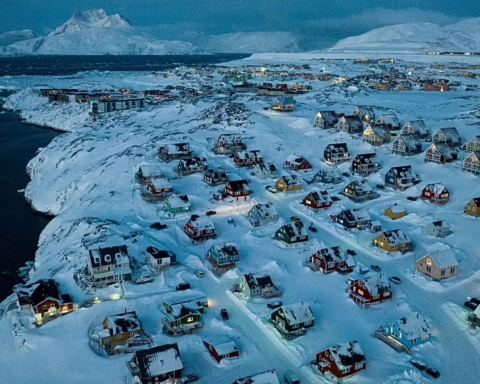
For centuries, the coastal communities of Greenland have relied on a predictable rhythm of seasonal ice to sustain their livelihoods and food security. However, the stability that once defined the Arctic landscape is vanishing, replaced by a volatile environment that poses an existential threat to traditional hunting and fishing practices. As the thick sea ice that served as a natural highway begins to thin and fracture prematurely, the indigenous hunters who rely on it are finding themselves increasingly stranded.
In the northern reaches of the island, dog sledding and ice fishing are not merely cultural touchstones but essential methods for harvesting Greenland halibut and seals. Historically, the ice reached a thickness and duration that allowed fishers to travel deep into the fjords during the winter months. Today, those windows of opportunity are shrinking. Local residents report that the ice is forming later in the year and breaking up much earlier than previous generations ever experienced. This unpredictability makes every excursion a high-stakes gamble, as thin patches can lead to life-threatening accidents for both humans and their sled dogs.
Beyond the immediate physical dangers, the changing ice cover is fundamentally altering the marine ecosystem. Many of the species that Greenlandic fishers target are sensitive to water temperature and light levels, both of which are affected by the presence or absence of sea ice. As the ice retreats, warmer Atlantic waters are penetrating further into Arctic basins, bringing with them new species that compete with native stocks. This shift forces local fishers to adapt their gear and techniques at a pace that financial and logistical constraints often make impossible.
Economic pressures are mounting as the reliability of the winter harvest wanes. In many remote settlements, there are few alternative employment opportunities. When the ice fails to harden, the supply chains that move fish from artisanal sleds to international processing plants are severed. This creates a ripple effect throughout the local economy, leading to food insecurity and a migration of younger generations toward larger hubs like Nuuk. The loss of these traditional practices represents more than just an economic downturn; it is a profound erosion of a cultural identity that has been forged over a millennium of survival in one of the world’s harshest climates.
International researchers monitoring the region have noted that the rate of ice loss in Greenland is outstripping previous climate models. While large-scale commercial fishing vessels might find new routes through open water, the small-scale traditional fisher is left behind. The infrastructure required to transition from ice-based fishing to open-water boat fishing is prohibitively expensive for most individuals in northern villages. Without significant intervention or support for adaptation, a way of life that has defined the Inuit people for centuries may soon be confined to history books.
Environmental experts argue that the situation in Greenland serves as a sentinel for the rest of the planet. The challenges faced by these fishers are a direct consequence of global atmospheric changes, yet the people most affected are those with the smallest carbon footprints. As the ice continues to thin, the global community is forced to reckon with the human cost of a changing Arctic. For the fishers of Greenland, the future is no longer written in the steady arrival of the frost, but in the anxious observation of a horizon that no longer offers the solid ground it once did.