Staff Report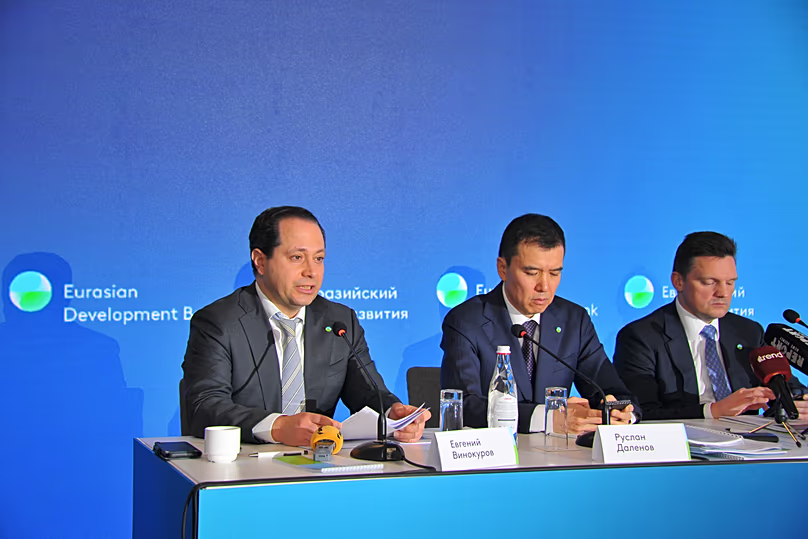
The economic landscape across Central Asia is experiencing a notable acceleration, with the Eurasian Development Bank (EDB) reporting a robust 6.6% growth in 2025, projected to ease slightly to 6.1% in 2026. This trajectory, encompassing Kazakhstan, the Kyrgyz Republic, Tajikistan, and Uzbekistan, stands in stark contrast to the more modest forecasts for advanced economies. For instance, the EDB anticipates the United States will see growth around 1.6% and the Euro area about 1.1% in 2026, while China is expected to expand by approximately 4.6% in the same period. These figures suggest a significant catch-up phase for the Central Asian bloc, even as fundamental economic disparities persist compared to larger, more developed nations.
Despite these impressive headline numbers, the day-to-day realities for many households in the region are often shaped more by persistent inflation, elevated borrowing costs, and income gains that remain uneven. Economists frequently point out that national growth statistics, while indicative of overall economic activity, do not always directly translate into improved living standards at the household level. Inflationary pressures have, in some cases, outpaced GDP growth, as seen in Kazakhstan last year where inflation reached around 12.3%, exceeding the economic expansion. The Kyrgyz Republic faced 9.1% inflation, and Uzbekistan recorded approximately 7.5%. These trends underscore a critical challenge: ensuring that the benefits of rapid economic expansion are felt broadly across the population.
The growth across the region is not uniform, with certain economies significantly outperforming others. The Kyrgyz Republic, for example, is leading the charge, with the EDB estimating a remarkable 10.3% growth in 2025 and a forecast of 9.3% in 2026. Uzbekistan follows, with expected growth of 7.4% in 2025 and 6.8% in 2026. Kazakhstan, the region’s largest economy, is projected to expand by around 5.9% in 2025 and 5.5% in 2026. These figures represent the strongest growth seen in the region in over a decade. Kubat Rakhimov, a Kyrgyz expert in infrastructural development, observes that for economies still catching up, a 6% growth rate signifies substantial progress, whereas advanced economies might consider 1.5-2% growth quite strong.
A significant portion of this recent economic dynamism in Central Asia, particularly in smaller economies, has been linked to the redirection of trade and logistics flows. Analysts suggest that the strong performance of the Kyrgyz Republic, for instance, reflects a reconfiguration of global supply chains following Russia’s invasion of Ukraine. Rakhimov highlights how Kyrgyzstan’s existing re-export infrastructure, traditionally moving goods from China to Russia, proved adaptable to these new geopolitical realities. This established network allowed for the seamless redirection of additional trade flows, without requiring the creation of entirely new logistical or financial channels. Furthermore, the nationalization of the Kumtor gold mine has bolstered public finances in the Kyrgyz Republic, enabling increased infrastructure spending and generating a short-term multiplier effect in sectors like construction and transport.
However, such growth drivers, reliant on geopolitical shifts, carry inherent vulnerabilities. Rakhimov cautions that growth fueled by geopolitical tensions is susceptible to external changes. While trade redirection has played a role, EDB data also indicates that domestic factors, including consumption and investment, are primary drivers of the expansion. Strong internal demand, rapid credit growth, and significant infrastructure projects have been central to this momentum. In larger economies like Kazakhstan, industrial investment, particularly in manufacturing and energy, has been crucial. The earlier-than-expected launch of expanded capacities at the Tengiz oil field, for example, contributed to an upward revision of Kazakhstan’s growth forecast. Uzbekistan’s expansion appears more broad-based, with robust investment in fixed capital and a significant surge in exports, largely driven by consistently high gold prices.
Despite the current optimism, economists foresee potential headwinds. The World Bank projects a more pronounced slowdown than the EDB, anticipating regional growth to cool to approximately 5.0% in 2026 and 4.6% in 2027. This outlook is influenced by slower growth among major trading partners and ongoing global trade uncertainties. Analysts warn that the current boom could fade under various scenarios, including a global economic downturn, the cessation of hostilities between Russia and Ukraine, or shifts in global demand for hydrocarbons and metals. In such circumstances, the “geopolitical rent” currently benefiting Central Asia could diminish. The challenge, as Rakhimov articulates, lies in transforming this temporary momentum into enduring economic strength through internal dialogue and diversified development strategies rather than solely relying on external geopolitical factors.