Staff Report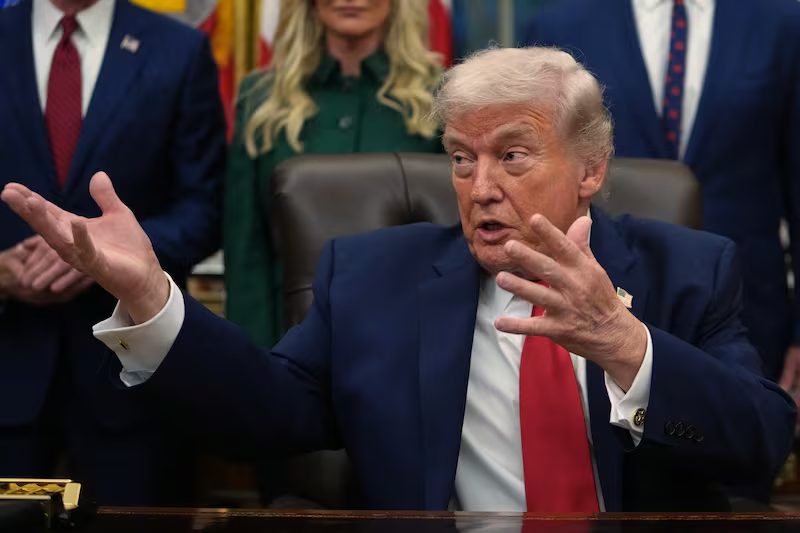
Concerns regarding former US President Donald Trump’s assertions about Greenland have prompted Rob Jetten, the centrist D66 leader poised to become the Netherlands’ next prime minister, to advocate for a more robust European cooperation. Jetten emphasized that Europe should prioritize strengthening its own security and prosperity mechanisms, rather than solely focusing on the United States. His comments surfaced as the Netherlands charts a new political course following recent elections, with a minority coalition government beginning to outline its policy agenda.
Jetten articulated his view to the Associated Press, suggesting that ongoing discussions and grievances about the US serve little purpose. Instead, he believes the focus should squarely be on bolstering European collaboration to independently guarantee the security and prosperity of its citizens. He indicated that one of his initial actions upon assuming office would involve engaging with European counterparts to identify how the Netherlands can contribute to this reinforced continental cooperation. However, Jetten also made it clear that enhancing collaboration with Washington, particularly on security matters, the conflict in Ukraine, and economic ties, would remain a priority given the interconnectedness of the Dutch and American economies.
Trump has consistently argued for US control over Greenland, a self-governing territory under Denmark, citing threats from Russia and China as justification. This stance led to a period of tension, which included threatened tariffs on several European nations, including the Netherlands, aimed at pressuring for US acquisition of the territory. These tariffs were ultimately rescinded last week. Jetten’s remarks came as he, alongside leaders from two other parties forming the new Dutch coalition, presented a policy blueprint for their upcoming four-year term.
The newly unveiled policy document, titled “Getting to Work,” outlines substantial commitments, including billions allocated to the Dutch military and continued support for Kyiv in the face of Russia’s invasion of Ukraine. The document frames the conflict in Ukraine as central to the security of the entire European continent. It further pledges sustained multi-year financial and military aid, alongside continued advocacy for the utilization of frozen Russian assets. This agenda will be pursued by a minority coalition government, which holds only 66 out of 150 seats in the lower house of parliament. This parliamentary landscape necessitates broad support across the fragmented political spectrum for any proposed legislation to pass, a challenge Jetten acknowledged by noting that the Netherlands’ historical strength lies in collaboration.
The incoming coalition comprises Jetten’s D66 party, alongside the more right-leaning Christian Democrats and the People’s Party for Freedom and Democracy. Jetten, at 38, is set to become the youngest and first openly gay prime minister of the Netherlands, with the swearing-in by King Willem-Alexander anticipated in late February. The task of forging this coalition fell primarily to Jetten after his party’s narrow victory in late October’s elections.
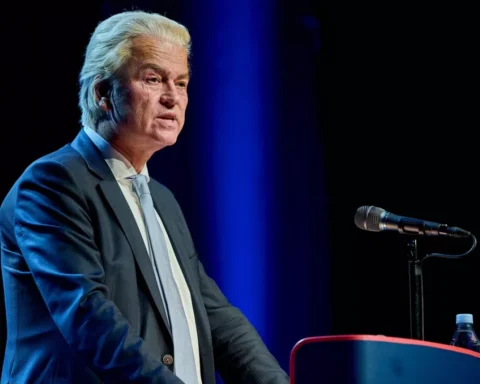
The path ahead for the minority government appears complex. Jesse Klaver, leader of the center-left Green Left-Labour Party, which holds a significant 20 seats, has described the coalition as a “risky experiment.” While Klaver has indicated a willingness to engage in “responsible opposition” and collaborate with the new government for the benefit of the Netherlands, he also cautioned that any proposals seeking their support would need to be more “social and more green.” Meanwhile, the far-right Party for Freedom, led by Geert Wilders, a close runner-up in the elections, has vowed not to support the new coalition. Further complicating the political landscape, Wilders’s party recently saw seven of its elected lawmakers depart to form a separate bloc in parliament, citing dissatisfaction with his leadership.