Staff Report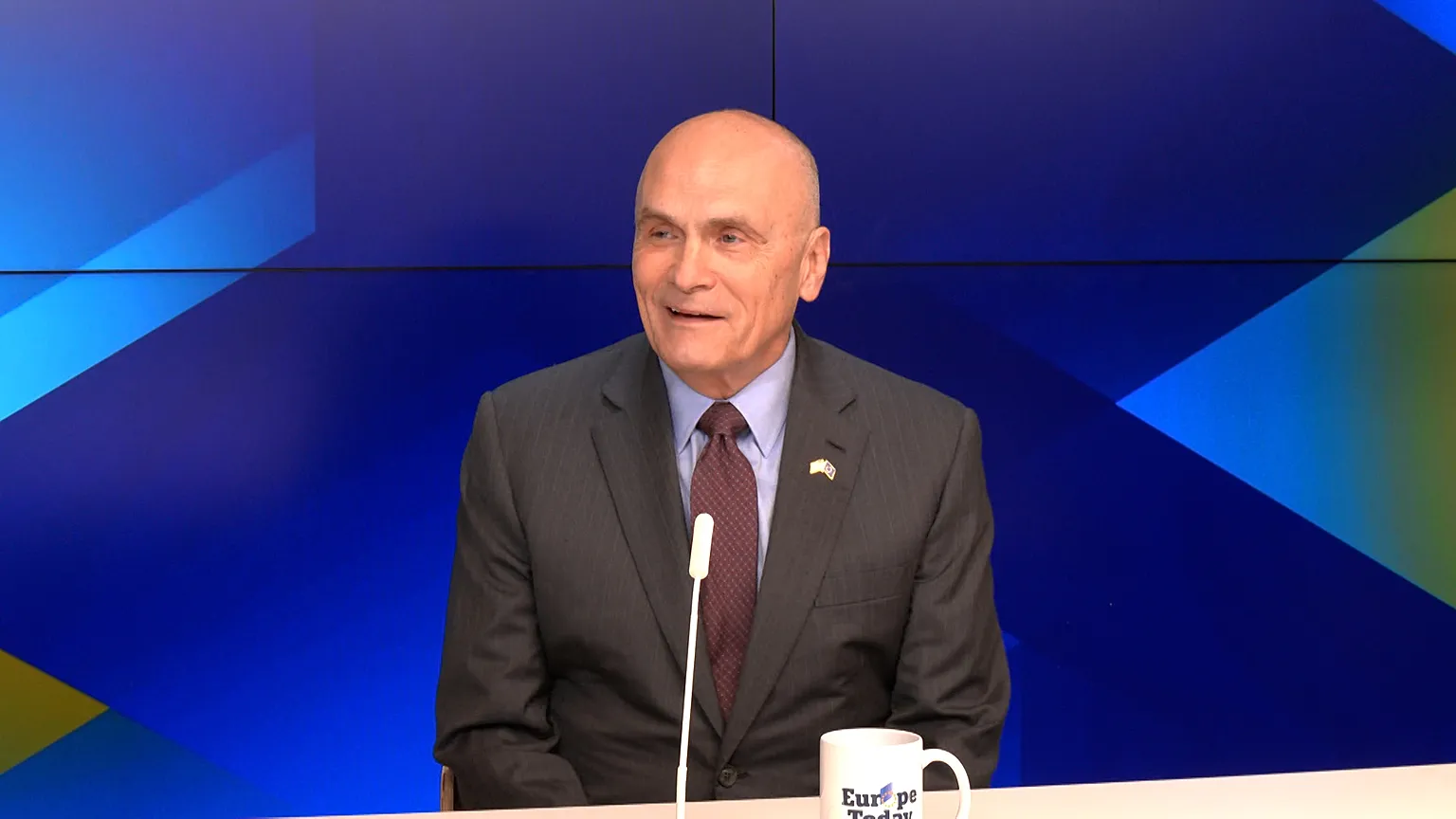
The United States views Europe as a “natural and indispensable ally,” but the strength of that relationship depends on Europe maintaining its own distinct identity and strategic autonomy, according to U.S. Ambassador to the European Union Andrew Puzder. In an interview with Euronews’ morning program Europe Today, Puzder emphasized that the transatlantic relationship functions best when Europe acts from a position of clarity—about its values, its institutions, and its long-term vision for global influence.
The remarks come at a delicate moment for the Western alliance. War continues in Ukraine. China’s geopolitical ambitions are accelerating. The global economy is fragmenting under pressure from supply chain realignment and rising protectionism. Meanwhile, internal debates within Europe on defense spending, industrial strategy, and migration policy are reshaping the identity of the European project.
Against this backdrop, Puzder’s message was both supportive and cautionary: Europe’s ability to remain Europe—culturally, politically, and strategically—is essential to the stability of the transatlantic partnership.
“Europe should not lose its identity” — a strategic reminder from Washington
Ambassador Puzder’s central argument is that the EU’s strength lies in the cohesion of its democratic values, its regulatory power, and its economic model. According to him, efforts to dilute or fracture this identity—whether through internal political polarization, foreign interference, or external economic pressure—would weaken Europe at a moment when the world needs its leadership.
“The United States does not want a Europe that mimics us,” Puzder stated.
“We want a Europe that is strong because it remains true to itself.”
The ambassador suggested that Europe’s unique social model, rule-of-law institutions, and commitment to democracy are what make it a credible partner for the U.S.—not simply its shared military alignment or economic ties.
Context: A Transatlantic Relationship Under Reinvention
The U.S.–EU partnership is undergoing one of its most significant transitions since the end of the Cold War. Several factors are contributing to this evolution:
1. Russia’s invasion of Ukraine
The war has forced Europe and the U.S. to coordinate more deeply on defense, sanctions, and energy security. The unity displayed so far has exceeded expectations, but the strain on Europe’s resources and political cohesion is undeniable.
2. Tensions over industrial and trade policy
The U.S. Inflation Reduction Act (IRA), with its green subsidies, sparked concerns in Brussels about industrial competition and the risk of investment flight from Europe. Efforts are ongoing to harmonize approaches without triggering a transatlantic trade war.
3. China as a “systemic rival”
Both Washington and Brussels increasingly view China through a geopolitical lens—but Europe maintains a more nuanced, multi-dimensional stance, given its economic exposure. Puzder acknowledged this complexity while urging Europe to remain aligned with its democratic values.
4. NATO burden-sharing (old debates, new urgency)
The U.S. continues to push Europe to increase defense spending, especially given uncertainties about future American administrations. Europe’s strategic awakening is happening, but unevenly.
Given these challenges, Puzder’s emphasis on “identity” reflects a broader U.S. desire for Europe to speak with one voice—and with clarity.
The ambassador’s deeper point: identity underpins resilience
Puzder’s comments tap into a deeper strategic philosophy:
Alliances are strongest when partners bring complementary strengths—not when they dissolve into uniformity.
For Europe, its power lies in:
- A unified market of 450 million consumers
- Regulatory leadership (GDPR, AI Act, environmental standards)
- Deep diplomatic networks
- Influence in international institutions
- A commitment to multilateral governance
- A cultural and historical heritage that supports democratic identity
According to Puzder, these elements give Europe its global force. The U.S. does not want Europe to become an extension of American policy but rather a confident, values-driven power capable of shaping world affairs.
Internal European debates pose challenges to that identity
Puzder’s remarks also indirectly acknowledge the internal strains on the EU:
1. Rise of nationalist and far-right parties
Growing influence of sovereigntist movements in France, Italy, the Netherlands, and Eastern Europe raises questions about unity on EU-wide policy.
2. Energy transition uncertainty
While Europe continues to lead globally on climate policy, the cost-of-living crisis has sparked political backlash.
3. Enlargement dilemmas
Bringing in Ukraine, Moldova, and Western Balkan states will require institutional reforms—and consensus among existing members.
4. Economic fragmentation
Diverging fiscal capacities between northern and southern EU states risk undermining cohesion.
Puzder’s message implicitly calls for Europe to navigate these tensions without losing the foundational elements that define the European Union.
Washington’s interests: A stable, assertive Europe
From a U.S. standpoint, a strong Europe helps to:
- Contain Russian aggression
- Balance China’s global influence
- Stabilize global trade
- Strengthen NATO
- Promote democratic values worldwide
A fragmented or identity-conflicted Europe, by contrast, would weaken the international liberal order and leave the U.S. more isolated in confronting global challenges.
A subtle warning about foreign influence
Puzder also noted that adversarial powers—particularly Russia and China—have an interest in encouraging political fractures within Europe.
“There are actors who benefit when Europe doubts itself,” he said.
This aligns with U.S. intelligence findings that foreign operations continue to target European political discourse, media ecosystems, and social tensions.
Transatlantic cooperation remains strong—but not automatic
Despite recent disagreements, Puzder emphasized that the U.S.–EU relationship is historically robust. However, he made clear that the partnership requires maintenance—not complacency.
Both sides must demonstrate:
- Strategic coherence
- Shared values
- Mutual respect for internal differences
- Clear long-term planning
For the U.S., this includes respecting Europe’s desire for greater autonomy. For Europe, it includes maintaining unity and preserving its democratic identity.
Conclusion: A Partnership Built on Identity, Not Imitation
Ambassador Andrew Puzder’s message—that Europe must “not lose its identity”—is more than a diplomatic soundbite. It is a strategic philosophy rooted in the belief that strong alliances require strong, self-assured partners. Europe’s capacity to remain Europe—defined by its values, institutions, and social model—is essential to the health of the transatlantic alliance.
In a world of rising authoritarianism, geopolitical instability, and economic fragmentation, Washington sees Europe not merely as an ally but as a co-pillar of the democratic order. The future of that partnership, Puzder suggests, depends not on Europe becoming more American, but on Europe remaining confidently and cohesively itself.