Staff Report
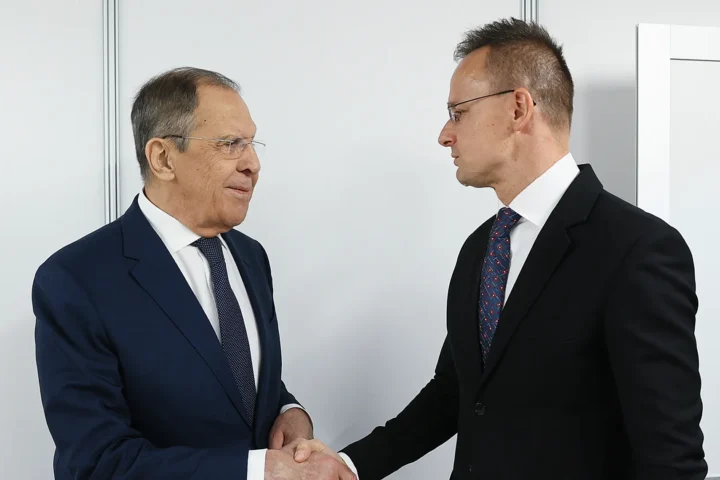
A series of high-level intelligence leaks has sent shockwaves through the European diplomatic community today, revealing that Hungarian Foreign Minister Peter Szijjarto provided Russian Foreign Minister Sergei Lavrov with detailed strategic briefings. The communications reportedly occurred just before a pivotal summit of European Union leaders, raising immediate concerns about the integrity of the bloc’s internal security and its unified stance against Russian aggression.
According to documents obtained by international investigative outlets, the exchanges between the two officials went far beyond routine diplomatic courtesy. The leaked transcripts suggest that Szijjarto shared sensitive insights regarding the specific negotiating positions of other EU member states. These briefings allegedly included details on planned sanctions packages and the internal fractures within the European Council regarding long-term military aid for Ukraine. By providing Moscow with a roadmap of the EU’s internal disagreements, Hungary has effectively compromised the collective bargaining power of the union.
The timing of these revelations is particularly damaging for Budapest. Prime Minister Viktor Orban has long been viewed as the outlier within the European Union, often using his veto power to stall or dilute measures intended to punish the Kremlin for its invasion of Ukraine. However, these new leaks suggest a level of active coordination that moves past mere political obstructionism into the realm of strategic collaboration. European diplomats in Brussels, speaking on the condition of anonymity, expressed a mixture of fury and resignation, noting that while Hungary’s leanings were well-known, the documented evidence of pre-summit briefings is a significant escalation.
Inside the Hungarian Foreign Ministry, officials have dismissed the reports as politically motivated disinformation designed to undermine the country’s sovereignty. They maintain that Hungary serves as a necessary bridge between the East and West, arguing that maintaining a dialogue with Moscow is essential for energy security and the eventual brokering of peace. Yet, this rationale finds little sympathy in Warsaw, Tallinn, or Berlin, where leaders view such backchannel communications as a direct betrayal of the mutual trust required to maintain a functioning geopolitical alliance.
The leaked information also highlights the technological vulnerabilities inherent in modern European diplomacy. While it remains unclear exactly how these transcripts were intercepted, the breach suggests that even the most sensitive ministerial discussions are being monitored by third-party actors. This incident is likely to trigger a comprehensive overhaul of how the European External Action Service handles classified briefings ahead of major summits. There is now a growing movement among several member states to restrict Hungary’s access to certain high-level intelligence folders to prevent further leaks to the Kremlin.
Legally and procedurally, the European Union finds itself in a difficult position. There are no clear mechanisms to expel a member state for sharing diplomatic intelligence, and the Article 7 proceedings already underway against Hungary for rule-of-law violations are famously slow and cumbersome. However, the political fallout will be immediate. The next time Peter Szijjarto sits down with his European counterparts, the atmosphere is expected to be ice-cold. The level of transparency and cooperation usually expected at the Brussels table has been fundamentally compromised.
As the European Union prepares for its next round of discussions regarding the future of the continent’s security architecture, the shadow of these leaks will loom large. The incident serves as a stark reminder that the greatest threats to European unity often come from within its own borders. For Sergei Lavrov and the Kremlin, the ability to peer into the inner workings of the EU before a vote even takes place is a significant tactical victory. For the rest of Europe, it is a wake-up call that the internal defense of their democratic institutions is just as critical as the defense of their physical borders.