 Staff Report
Spanish Prime Minister Pedro Sanchez has taken a definitive stand against the geopolitical trajectory of the United States under President Donald Trump, signaling a significant shift in the traditionally stable relationship between Madrid and Washington. In a series of recent statements, the Spanish government clarified its refusal to engage in new military escalations, effectively distancing itself from the more aggressive foreign policy stances currently emanating from the White House. This decision represents a high-stakes political gamble for Sanchez, who is attempting to solidify Spain’s role as a sovereign leader within the European Union while risking potential economic or diplomatic retaliation from a volatile American administration.
The friction between the two leaders stems from divergent views on international security and the necessity of military intervention in global hotspots. While the Trump administration has signaled a desire for increased NATO contributions and a more assertive military posture in various regions, Sanchez has prioritized a policy of de-escalation and humanitarian focus. By explicitly stating that Madrid will say no to war, the Prime Minister is appealing to a domestic base that remains wary of foreign entanglements, yet he is doing so at the cost of alienating Spain’s most powerful transatlantic ally.
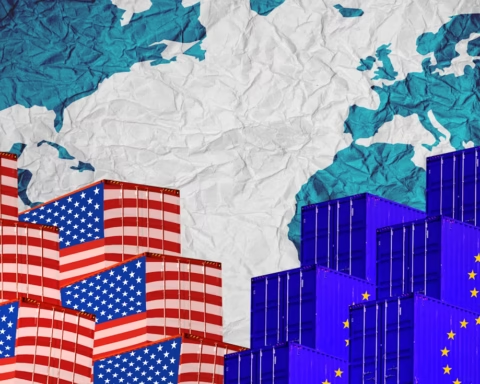
Economic analysts suggest that this diplomatic defiance could have ripple effects beyond the halls of government. The United States remains a vital trade partner for Spain, and any cooling of relations could impact sectors ranging from defense procurement to tourism and agricultural exports. However, Sanchez appears to be betting that the European Union will provide a sufficient protective umbrella. He is positioning Spain alongside other continental powers like France and Germany, who have also expressed reservations about the unpredictability of current American foreign policy. By aligning with the broader European consensus, Sanchez hopes to mitigate the risks of a bilateral fallout with Washington.
Inside the Spanish parliament, the move has drawn both praise and sharp criticism. Supporters of the Prime Minister argue that Spain must maintain an independent foreign policy that reflects its national values and historical preference for multilateralism. They see this as a moment of maturity for the nation, standing up to a superpower when interests do not align. Conversely, opposition leaders have warned that Sanchez is playing a dangerous game with Spain’s security architecture. They argue that rebuffing the United States could lead to diminished intelligence sharing and a weaker position within the NATO alliance, potentially leaving Spain vulnerable in an increasingly unstable global environment.
As the situation unfolds, the international community is watching closely to see how the Trump administration responds to this public rejection of its strategic goals. Historically, President Trump has not hesitated to use tariffs or diplomatic pressure to bring allies in line with his vision. If Washington chooses to penalize Madrid, it could force Sanchez into a difficult corner, testing his resolve and the strength of his coalition government. For now, the Prime Minister remains steadfast, insisting that Spain’s commitment to peace and international law is not negotiable, even when faced with pressure from the world’s largest military power.
This tension highlights a growing trend of middle-power defiance against the shifting norms of the post-Cold War era. As traditional alliances are re-evaluated, leaders like Sanchez are forced to choose between the safety of long-standing partnerships and the pursuit of a more autonomous national identity. The coming months will determine whether this gamble pays off in the form of increased European influence or if it results in a costly isolation that hampers Spain’s strategic interests on the global stage.