Staff Report
The Strait of Hormuz has long been identified as the world’s most critical maritime chokepoint, primarily for its role in the global energy trade. Every day, roughly one-fifth of the world’s total oil consumption flows through this narrow passage between Oman and Iran. However, a growing body of economic research and geopolitical analysis suggests that a disruption in these waters would trigger a catastrophe far beyond the gas pump. The most immediate and devastating impact of a blockade would likely be a systemic collapse of the global food supply chain.
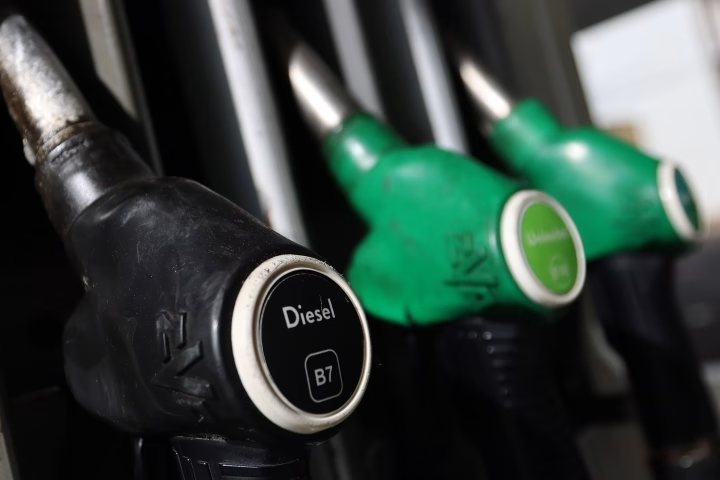
Agricultural production in the modern era is inextricably linked to energy costs. If the Strait of Hormuz were to be closed due to military conflict or political posturing, the price of crude oil would likely skyrocket to unprecedented levels. This surge would immediately translate into higher costs for farmers globally. Modern farming relies heavily on diesel for machinery and natural gas for the production of nitrogen-based fertilizers. When these input costs rise sharply, the price of staples like wheat, corn, and soy follows suit, often within weeks. For developing nations that spend a significant portion of their GDP on food imports, this inflationary pressure can lead to widespread famine and civil unrest.
Beyond the cost of production, the physical logistics of moving food across the planet would be thrown into chaos. Shipping companies would face astronomical insurance premiums to operate in the Middle East, if they are able to secure coverage at all. Many of the world’s largest container ships and bulk carriers must navigate through or near these waters to reach markets in Asia and Africa. A blockade would force these vessels to take longer, more expensive routes around the Cape of Good Hope. This detour adds thousands of miles to a journey, delaying the arrival of perishable goods and increasing the carbon footprint and fuel consumption of every shipment.
Furthermore, the Middle East itself is a major importer of food grains. Countries like Saudi Arabia, the United Arab Emirates, and Qatar rely on the stability of these shipping lanes to feed their populations. A prolonged closure would create a localized humanitarian crisis that would quickly spill over into international markets as these wealthy nations compete for limited supplies from other regions. This competition drives up prices for everyone else, effectively pricing out the world’s most vulnerable populations in Sub-Saharan Africa and Southeast Asia.
The geopolitical stakes are equally high for fertilizer exports. The region surrounding the Persian Gulf is a primary source of the chemicals required to sustain global crop yields. If the flow of these essential minerals is interrupted, the impact on the next year’s harvest could be even more severe than the immediate price spikes. Farmers who cannot afford or access fertilizer will see significantly lower yields, creating a multi-year cycle of scarcity that the world is currently ill-equipped to handle.
International policymakers have historically focused on the Strait of Hormuz as a military and energy concern. While those factors remain vital, the narrative is shifting toward a more holistic view of maritime security. Ensuring the free flow of commerce through this narrow strip of water is not just about keeping the lights on in Western cities; it is about ensuring that the global population can afford to eat. As tensions in the region fluctuate, the international community must recognize that the Strait of Hormuz is the linchpin of a fragile global ecosystem that connects the oil fields of the Middle East to the dinner tables of the world.