 Staff Report
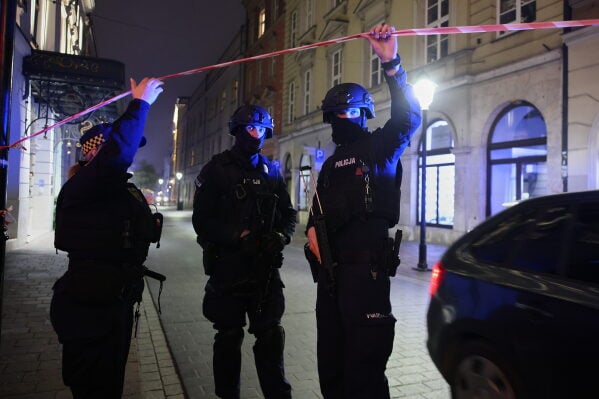
Prime Minister Donald Tusk’s government has ordered a review of Poland’s firearms laws after a gunman killed six people and wounded 16 others in Krakow’s Main Square, an attack that has shaken a country where mass public shootings were previously unknown.
The shooting took place on November 7 in the heart of Krakow’s Old Town, a district that draws millions of visitors each year. The 24-year-old attacker drove through the square and opened fire with a military-style rifle before he was stopped in a shootout with police. He later died in hospital.
A government review
Hours after the assault, senior officials said the tragedy would lead to tighter scrutiny of gun ownership. Deputy Defence Minister Magdalena Sobkowiak-Czarnecka said the government should limit the number and types of weapons that civilians can keep, arguing that the attack showed the danger of allowing individuals to accumulate large arsenals.
Deputy Interior Minister Czeslaw Mroczek said the interior ministry would review permit procedures after an urgent meeting of ministries, police and security services. He stressed that the police and his ministry were opposed to any further liberalisation of gun rules.
The attacker and his weapons
Prosecutors identified the gunman as Michal Oksinski, a resident of Ostrowiec Swietokrzyski, a city about 150 kilometres north-east of Krakow. He held a firearms permit and had several legally registered weapons at his family home.
When police searched the home after the attack, they found the bodies of his parents and sister, whom investigators believe he killed before travelling to Krakow. In total, 11 firearms matched permits issued to Oksinski and his father.
Oksinski carried two semi-automatic AR-15 rifles and two handguns during the attack, along with roughly 500 rounds of ammunition. Interior Minister Marcin Kierwinski said the attacker held radical, ultranationalist views and appeared to have been influenced by far-right ideology.
Rare violence in Poland
Mass shootings have been rare in Poland, a country of about 37 million people where around one million firearms are now registered. The number of gun permits has risen sharply in recent years, from roughly 235,000 in 2020 to almost 412,000 by the end of 2025.
The previous conservative government widened access in 2023 by allowing members of uniformed services to apply for personal protection permits, a move supporters said would strengthen national defence. President Karol Nawrocki has since called for a public debate on making firearms more accessible to ordinary citizens, arguing that trained, armed civilians are a valuable part of national security.
Political divide
Tusk's coalition now appears ready to move in the opposite direction. The government's response has turned the Krakow attack into one of the sharpest dividing lines ahead of parliamentary elections expected next year.
Opposition parties on the right, including the nationalist Confederation party, have argued that easier access to firearms makes citizens safer and better prepared for conflict. The ruling coalition says the shooting proves that Poland should tighten, not loosen, its gun laws.
What comes next
Prosecutors are treating the assault as a terrorist offence and have said the gunman acted alone, though they caution it is too early to establish a full motive. National mourning has been declared and a silent march is planned in Krakow.
The review ordered by Tusk's government could lead to stricter limits on the number of weapons per permit holder, tighter controls on certain types of firearms, and new rules for storing guns at home. Whatever the outcome, the attack has ended Poland's sense that large-scale gun violence was something that happened elsewhere.