Staff Report
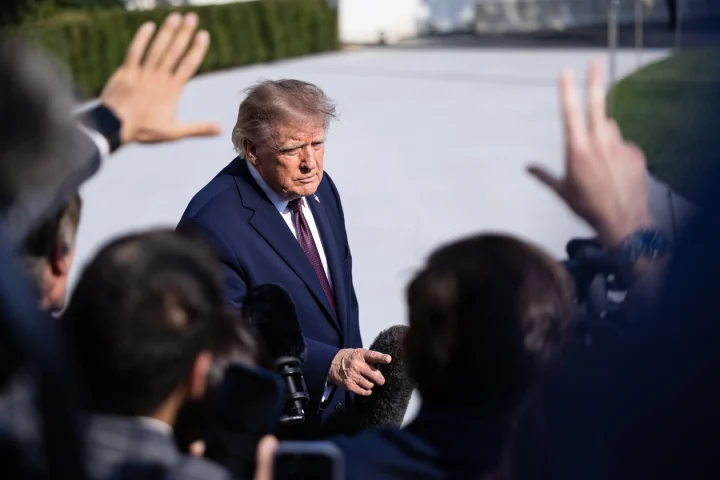
The diplomatic relationship between Washington and Berlin appears to be entering a period of significant volatility as Donald Trump ramps up his public critiques of German political leadership. In a series of pointed statements, the former president has targeted Friedrich Merz, the leader of Germany’s Christian Democratic Union, signaling a potential shift in how a future American administration might handle its oldest European alliances. This latest escalation centers on the long-standing debate over military expenditures and the physical presence of American forces on European soil.
At the heart of the dispute is a fundamental disagreement over the burden of collective defense. For years, American policymakers across the political spectrum have urged European nations to meet the North Atlantic Treaty Organization’s spending targets. However, the rhetoric coming from the Trump camp has taken on a more transactional and urgent tone. By specifically naming Friedrich Merz, who is widely seen as a primary contender for the German chancellorship, Trump is effectively injecting himself into the domestic politics of Europe’s largest economy. This move suggests that any future bilateral cooperation will be strictly predicated on immediate and substantial increases in German defense outlays.
The friction reached a new peak following suggestions that the United States might reconsider its troop deployments in Germany. Currently, thousands of American service members are stationed at bases like Ramstein and Grafenwoehr, which serve as critical logistics hubs for operations across the Middle East and Africa. To the German establishment, these bases are a symbol of a shared security guarantee. To Trump, they represent a lopsided financial arrangement where American taxpayers subsidize the security of a wealthy economic competitor. His focus on Merz indicates that he views the current German political trajectory as insufficient to meet his demands for a radical rebalancing of costs.
Friedrich Merz finds himself in a delicate position. As a conservative leader who generally favors strong transatlantic ties, he must navigate the pressure of maintaining a robust alliance without appearing to capitulate to external threats. The German public remains deeply divided over the prospect of massive military expansion, and the political fallout of a potential American withdrawal would be catastrophic for the regional security architecture. Merz has previously advocated for a more self-reliant Europe, but the speed and intensity of the current American rhetoric may force him to accelerate those plans faster than the German budget or electorate can handle.
Observers in Brussels and Washington are watching this development with growing concern. If the relationship between a potential future president and a potential future chancellor begins on such adversarial terms, the stability of the entire Western alliance could be at risk. The prospect of a troop withdrawal is no longer viewed as a mere rhetorical flourish; it is being treated as a legitimate policy tool that could be enacted to leverage concessions. This strategy of maximum pressure aims to shock the European system into a new reality where the American security umbrella is no longer a guaranteed constant.
As the political calendar advances in both nations, the rhetoric is likely to sharpen. For Merz, the challenge will be to present a vision of German sovereignty that satisfies domestic voters while offering enough strategic cooperation to keep the United States engaged. For Trump, the goal remains a complete overhaul of international agreements that he perceives as unfair to American interests. The coming months will determine whether this public spat is a temporary negotiation tactic or the beginning of a permanent fracture in the geopolitical order that has defined the last seventy years.