Staff Report
European Central Bank President Christine Lagarde has issued a stark warning regarding the potential economic fallout from escalating tensions in the Middle East. Speaking at a high-level summit in Washington, Lagarde emphasized that a prolonged conflict between Iran and Israel could have a material impact on global energy prices, subsequently derailing the hard-won progress made in stabilizing inflation across the eurozone.
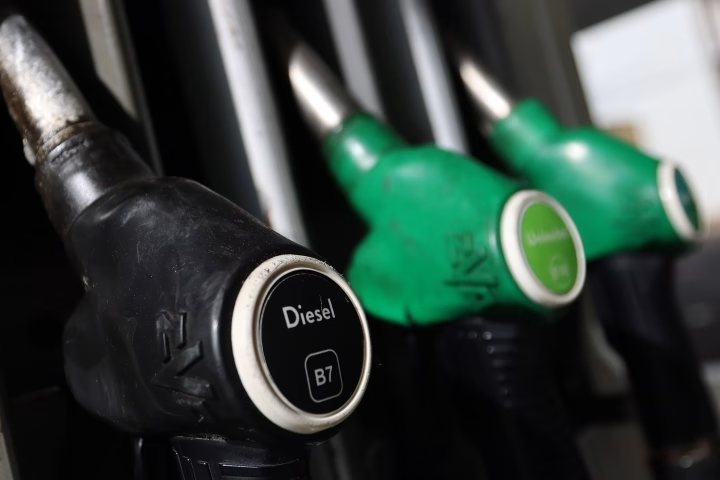
The central bank chief noted that while the European economy has shown signs of resilience in recent months, the threat of geopolitical instability remains the most significant wildcard for monetary policy. Shifts in the price of crude oil and natural gas have historically acted as primary catalysts for consumer price spikes in Europe. Lagarde suggested that any disruption to supply chains or trade routes in the region would force the ECB to reconsider its current trajectory toward interest rate cuts.
Market analysts have been closely watching the ECB for signals regarding a potential rate reduction in June. However, Lagarde’s recent comments suggest that such a move is not guaranteed if external shocks pressure the energy market. The central bank is currently balancing the need to stimulate a stagnant European economy with the mandate of keeping inflation near the two percent target. A sudden rise in imported energy costs would effectively act as a tax on consumers, reducing household purchasing power and increasing production costs for industrial giants in Germany and France.
Beyond energy, Lagarde pointed to the broader psychological impact that regional warfare has on global markets. Increased uncertainty often leads to a tightening of credit conditions and a reduction in foreign direct investment. For a continent already grappling with the economic aftershocks of the war in Ukraine, a second major geopolitical crisis could lead to a period of stagflation, where prices rise even as economic growth remains flat or negative.
The ECB’s Governing Council remains data-dependent, but Lagarde’s rhetoric has shifted to include a more cautious outlook on the international security landscape. She argued that central banks must remain vigilant against ‘exogenous shocks’ that fall outside the traditional scope of domestic economic modeling. The interconnectedness of global trade means that a localized conflict in the Middle East can rapidly manifest as a cost-of-living crisis for citizens in Brussels, Madrid, and Berlin.
As the situation develops, the European Central Bank is expected to maintain a flexible stance. If oil prices remain volatile, the push for aggressive monetary easing may be postponed. Lagarde concluded her remarks by calling for greater international cooperation to mitigate the economic risks posed by regional instability, noting that the global economy is currently in a fragile state of recovery that cannot easily withstand another major supply-side disruption.